James and Cam’s Sibling Relationship
To the LighthouseJames and Cam’s Sibling Relationship is a close but unsettled alliance shaped by their father’s authority. On the voyage to the lighthouse, the siblings silently pledge to resist his commands together; as the journey unfolds, however, Cam’s affection for their father complicates the pact, while James fears that she will abandon him to oppose their father alone.
Identity and Shared Position
James and Cam are brother and sister in the Ramsay family. Their shared position as children under their father’s authority gives them a common grievance, but their alliance is not founded on identical feelings. James reads resistance as a matter of justice and constancy; Cam is also angry at their father, yet feels drawn to him in ways that make a simple division between siblings and parent impossible.
That tension has roots in the family’s earlier life. Their mother’s practical care includes knitting a stocking for the lighthouse keeper’s young son, and her concern for the children and their individual gifts supplies a contrasting model of family attention. The siblings’ later compact, by contrast, forms in response to the father’s insistence that they accompany him. Their solidarity is real, but it develops inside a family where care, authority, affection, and resentment are entangled.
The Compact Against Their Father
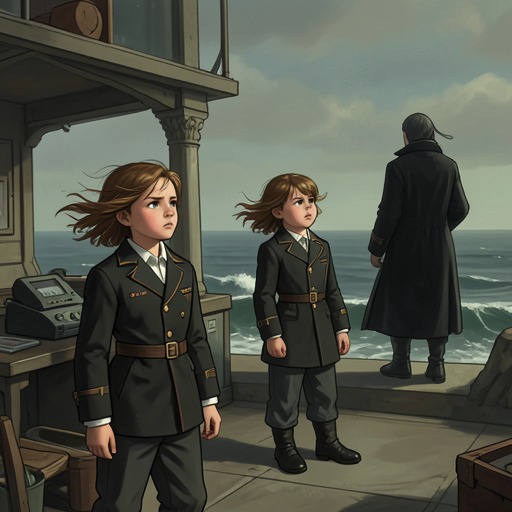
On the way down to the beach, James and Cam fall behind their father without speaking. They carry the parcels he has ordered them to bring and make a silent vow to stand by each other and resist tyranny. Their agreement turns their shared reluctance into a principle: they hope the sea will remain calm, the expedition will fail, and they can return to shore rather than comply with their father’s wishes.
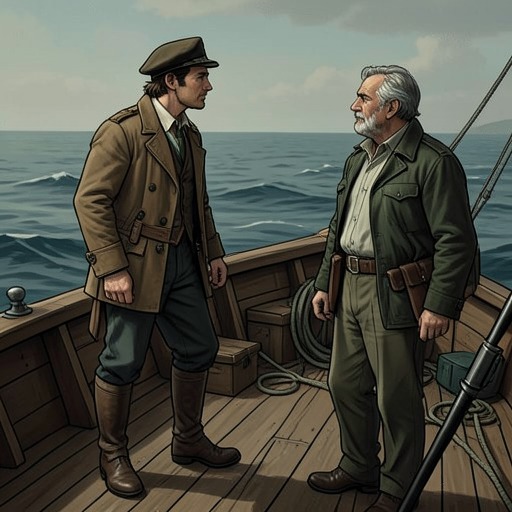
Once they are aboard, their father’s impatience and command of the journey keep the conflict present. James steers while Cam sits in the bow, and both resent being made to come. When the boat begins moving, their father settles into the voyage and the children remain conscious of the difference between his pleasure and their own sense of compulsion. The compact gives them a shared language for that difference, though it does not make them equally able to resist him.
A Bond Tested by the Voyage
The journey’s changing pace briefly loosens the siblings’ alignment. As the breeze freshens and the boat speeds over the water, Cam becomes absorbed in the movement and feels the tie between her and James slacken. James, still intent on steering, imagines that they might escape and be free. For a moment, the voyage offers both siblings a sense of possibility, but it does not lead them toward the same response: James remains fixed on the conflict, while Cam is carried into the experience of the crossing.
Their father’s account of a storm and the rescue of ships further complicates their shared anger. Cam feels pride in him as she imagines that he would have gone to the wreck and helped, even while remembering that he has forced them to join the expedition. Her judgment holds admiration and resentment together. James, meanwhile, fears that Cam’s responsiveness to their father will leave him alone in their resistance. The siblings share an understanding of his power over them, but they do not interpret his character in the same way.
James’s Fear of Losing Cam’s Support
When their father tries to draw Cam into conversation by asking about the family puppy, James watches for signs that she will give way. He expects her to answer and imagines that he will be left to carry out the compact alone. For him, Cam’s possible accommodation would be a breach of solidarity, even though her silence does not mean that she has stopped caring about him.
Cam’s inward conflict is more divided than James can see. She wants to answer their father warmly, perhaps even to share a private recollection about his childhood dog, but cannot find words that would preserve her loyalty to James and express her own affection for their father. She recognizes both her brother’s insistence on justice and her father’s appeal to her sympathy. Her silence therefore records not indifference but competing loyalties: she is reluctant to betray the compact, and equally reluctant to deny her attachment to the parent against whom it was formed.
An Alliance Without Resolution
Cam ultimately does not give James the clear reassurance he expects. She remains silent and occupies herself with the water, while James concludes that she is different and will not give way in the manner he had anticipated. Her inward wish to respond to their father remains private, leaving the siblings’ pact intact as an outward position but strained by an affection James does not fully perceive.
The relationship’s force lies in this mismatch between common grievance and unequal feeling. James’s loyalty to Cam depends on her standing with him against their father; Cam’s loyalty includes both her brother and a father whose authority has hurt her, but who still attracts her love and admiration. Their bond is neither dissolved nor neatly reconciled on the voyage. Instead, it appears as a fragile alliance that can hold shared resistance while leaving each sibling alone with feelings the other cannot entirely know.